Quality confirms that a product works today. Reliability predicts how long it will work tomorrow. The difference between the two determines warranty costs, maintenance intervals, and customer trust. Reliability Engineering provides the analytical tools to turn that prediction from an assumption into a number — early enough to act on it.
Failure Analysis — Find It Before the Customer Does
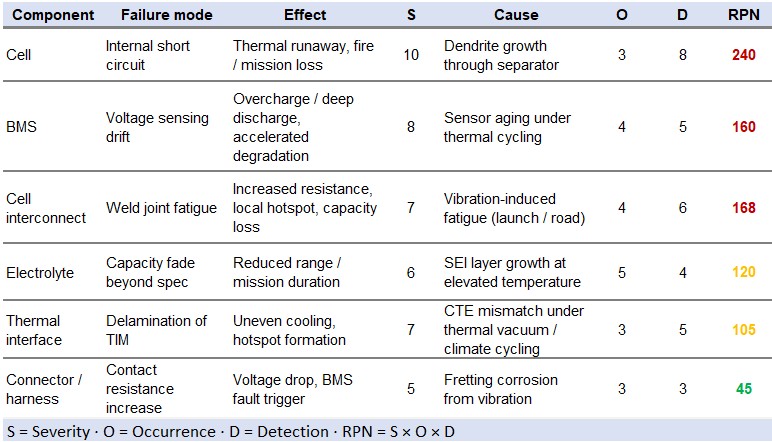
Proven analytical methods — FMEA and FMECA — systematically identify what can fail, how it will fail, and what the consequences are. Criticality ranking based on severity, occurrence, and detection ensures that engineering resources focus on the failures that matter most, not the ones that are easiest to fix.
Scope of work:
Failure mode analysis (FMEA / FMECA) with criticality ranking
Functional failure analysis at system and subsystem level
Risk prioritisation and mitigation planning
Standards compliance per ECSS-Q-ST-30-02C and industry-specific norms
Life Data Analysis — Quantify, Don't Estimate
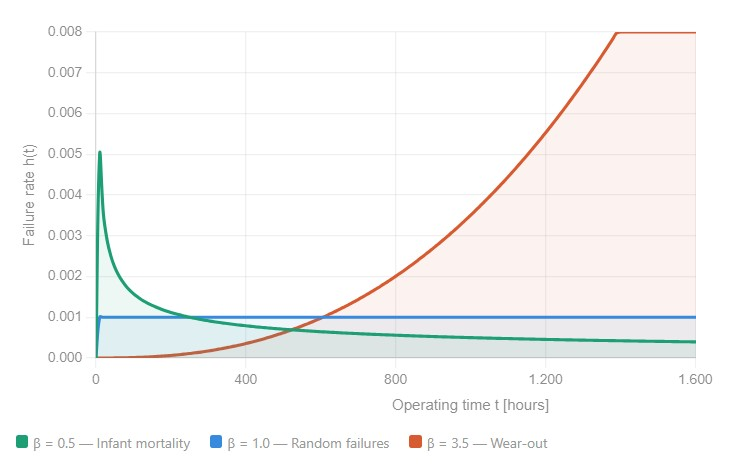
Weibull analysis transforms raw failure data into actionable engineering intelligence. The shape parameter reveals whether failures are driven by infant mortality, random events, or wear-out — each demanding a fundamentally different response. Combined with reliability growth tracking, the analysis provides a clear picture of where a product stands and what it takes to improve.
Scope of work:
Weibull-based life data analysis and failure prediction
Reliability modeling and growth tracking
Warranty period optimisation and maintenance interval definition
Statistical parameter estimation and confidence assessment
Testing & Qualification — Accelerate the Answer
Identifying design limits early saves months of redesign later. Qualification testing programmes combine accelerated methods with standard-compliant verification — whether the target is a series-production component or a space-qualified assembly.
HALT and HASS testing reveals design weaknesses and screens production defects. Quantitative accelerated life testing extrapolates field performance from compressed test durations. Environmental qualification campaigns — thermal, vibration, shock, EMC — verify survivability under the conditions the product will actually face.
Scope of work:
HALT / HASS test planning and result interpretation
Accelerated life test design with stress-life modeling
Environmental test specification per MIL-STD-810H and ECSS-E-ST-10-03C
Test-to-field correlation and acceleration factor calculation